A cautionary tale
How a dream house of the ’80s became a distress sale of the ’90s
By Jack Beaudoin
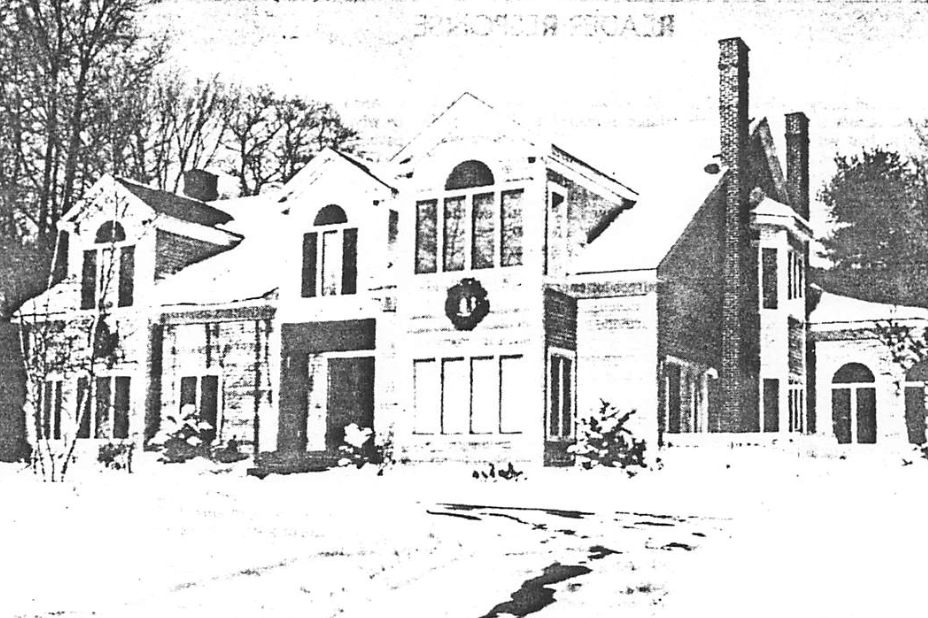
IN THE GATHERING DUSK, 60 people huddled in a wide semi-circle at the mouth of Joan Steeves’ three-car garage. While a few were dressed casually, in jeans and Bean sweaters, most were in three-piece suits or long dresses and woolen blazers, bankers and lawyers, there for a public foreclosure auction. “I was a millionaire,” Joan Steeves said, after the crowd had left. “But after the market crash in 1987 and then this fiasco, well, forget it.” The fiasco she was referring to is a 7,400 square-foot house she once called home. Steeves and her former husband James Swarz built the “cape scale” mansion several hundred yards up from the shore in 1986, the peak of Cumberland’s boom years. It cost them nearly $800,000. Six years later, Steeves watched the house sold off the auction block for half that price. “To sell this house at $395,000 is an absolute disgrace,” she says. This is the greatest miscarriage of justice in the world. “When I heard the auctioneer say going, going, gone, I could have sunk through the cement.” The bank, however, barely recovered its mortgage and resultant costs. “Obviously you don’t get this type of property very often,” says Jill Russell of Auction Properties, Ltd., the company that handled the Steeves sale. “You don’t find too many going at this price range yet ” Sandy Doughty of Coldwell-Baker-Beecher, a local Realtor, confirms. “The banks have too much money in them.” The Steeves auction is evidence of how the economic boom and subsequent recession affected Maine, and how some people viewed real estate investments. According to Wayne Taylor of Recoll Management — the Fleet Financial Group subsidiary charged with liquidating the $346,000 mortgage for the FDIC — Steeves hadn’t made a payment on the house since May of 1989. “I think that three years without any servicing whatsoever on the mortgage suggests the reasons for the foreclosure,” he said.
A matter of having equity It’s a fact Steeves won’t dispute. “The bank will say the agreement was to pay every month. And they’re right about that. But I thought, there’s so much equity in that house, I’ll live off that money. The reason the bank didn’t move in until now is because they knew it.” She also owed the town of Cumberland nearly $30,000 in taxes over the past three years. “I let the bank pick it up,” she said. “The house wasn’t running out of money. Most people don’t walk around with this kind of equity.” Steeves estimated that she had nearly half a million dollars in equity. The house had been listed with real estate agents at just over a million last year, although to “appease” the bank she dropped the price to $680,000. But it never sold. “What is their problem?” she still wonders. “So I owed them $100,000. They’re sitting on a million dollar house!” But the problem with that kind of thinking, as Recoll’s Taylor is quick to point out, is that when the market went soft, real estate values fell, and with them, equity. Recoll’s appraisal came in at just over $500,000. “It might have been worth more once upon a time,” Taylor conceded, “but a falling market can burn a lot of people.” “I’m not unique,” Joan Steeves maintained. “Most of the world is in a similar predicament. Knock on any door, the people behind it have trouble paying their bills. It’s a national problem.”
The house that Joan built Steeves may not be unique, but her house is. When she moved here from Fort Worth, Texas in 1986, she brought with her a solid mahogany door with leaded glass in a brass frame. Just behind the door, the foyer’s floor contains 490 square feet of unblemished marble. Sparsely furnished, the entryway is cavernous. A grandfather clock marks time with a low tock and at the end of the foyer, an oak spiral staircase twists towards the second floor. Sitting in what once was her living room, Steeves described some of the other amenities of the house: a German cook stove, solid oak cabinetry, birch casings, a solarium, 101 Anderson High Performance windows (alone worth $30,000). “Where are you going to find a floor like this?” she asked. “This floor is worth more than most people’s furniture. This is solid walnut. I’ve heard walnut’s so rare that people in the South go around stealing trees in the middle of the night.” The house has 11 heating zones, three fireplaces, three-and-a-half baths, four bedrooms (the master bedroom covers 860 square feet), and a three-car heated garage. All this on an acre of prime real estate not far from the ocean. The couple considered their house a high-income investment. Putting in a double Jacuzzi and Swedish sauna was as much a business decision as it was a matter of personal taste. When she and Swarz built the house six years ago, they decided they would live in it for five years and then sell it at a profit. But from the very start, things went wrong. Steeves planned to build a 4,000 square foot home — the architect’s renderings pushed it up to 6,300 sq. feet. The maid’s quarters over the garage added another 1,000 square feet. At that point she hesitated. Steeves said her costs shot up from $59.67 per square foot to $102. But even at this figure, observers say, the house was a steal. “That was a very reasonable figure, if accurate,” Sandy Doughty. “Other houses by the same contractor were going up for twice that amount.” Steeves and Swarz went ahead. Even after the house was built, there were lawsuits with the contractor and subcontractors. “I lost in Superior Court,” Steeves said of those battles, ” but we won the appeal in Supreme Court. Still, there were $20,000 in legal fees.” “Not to mention the maintenance,” she continued. “The casings around the living room and dining room were done in low-grade pine. The knots were coming out — we had to tear it out and replace it with birch. The finishing was terrible and had to be redone. There was a man employed here five days a week for one year. I really went through a great deal with this house.” And that’s how a house that was originally estimated to cost $334,000 ended up at $800,000.
Husband bolted without paying Still Steeves and Swarz believed that they couldn’t lose money on the house. The would live in it until they found a buyer, even if it took a few years. Steeves said she put up the down payment money and Swarz agreed to pay off the mortgage. “But when it came time to start the payments,” she said, “he took off. ” Swarz quitclaimed the deed over to Steeves in March 1989 and left the state. According to Steeves, Swarz had brought a six-figure debt into their marriage without ever telling her. And then he left her with a six-figure debt of her own.
The view from the auction On the day the house was auctioned off, registered bidders who had put down a $25,000 registration deposit got a tour of the house. Steeves and her family remained in the kitchen while an Auction Properties, Ltd representative led the viewers through. According to auctioneer Peter Zafirson, it’s rare that the owner is still in the house come the day of the auction. The preview opened every door and most closets — one lawyer went so far as to flush the toilets on the second floor to make certain they were running. “It’d make a pretty good bed and breakfast,” one of the prospective bidders joked, passing between the sauna and the Jacuzzi. Until he went on the tour, Ray Bernier of Westbrook had been thinking about buying the house as an investment. But before the auction began, he had already decided not to bid. “I wasn’t that impressed with it,” he said. Kathy and Richard Raubeson of Auburn saw a new home, not an investment, and they were impressed. In the parlance of Realtors, they were “motivated buyers.” And they had been thinking about buying the house for several weeks. “We came down and saw the house in September,” Kathy Raubeson said, “and we fell in love with it.” Even though they had been inside the house on their first visit, they had gone on the tour again. It left Kathy Raubeson unsettled. “I felt like an intruder this time,” she said. “I know how I would have felt if they had been foreclosing on me.” George Masters was a neighbor. He lived close enough to point out his house beyond the woods, 200 yards away. He was also a bidder. He was considering the Steeves house as either an investment or a home, probably a little of each. “Depends,” he said. “Depends on what it goes for, what the resale value would be. I’ve lived in houses smaller than the entryway.” Steeves appeared on the back steps just before Thomas Saturley, the auctioneer, opened the bidding. She smiled frequently. With a video camera recording his every word and movement, Saturley opened the bidding at $500,000. It took only three minutes before he had dropped his starting price 100 grand.
As low as $300,000 The bank finally put in a bid of $300,000. That, evidently, was the absolute floor. With a little cajoling Saturley got the bid up to $325,000, but it stalled again. He seemed to know who the serious bidders were and he approached each of them at some point during the bidding. He talked to the Raubesons once, and they left soon after — they’d been looking to buy in the low $300s. In another 10 minutes, Saturley had pushed the bid up to $380,000. He whispered with the bank’s representative for several minutes, and when he returned to the center of Steeves’ garage, he announced, “Ladies and gentlemen, this is a confirmed sale. There will be no tomorrow. We are going to sell this property today.” For the first and only time all evening, Joan Steeves reacted visibly to the proceedings. She leaned back against the wall of her garage, hands folded behind her, and exhaled. There was little more drama between that point and the final bid that Brian Kroot of Falmouth put in: $395,000. In the driveway of what had once been her home, Steeves remained defiant. “This is criminal,” she said: “To sell this house at $395,000 is an absolute disgrace. This is the greatest miscarriage of justice in the world. “When the bank’s own appraiser came, he said this house was magnificent, it was better-built than he’s even seen. According to him, the only places comparable are out on Prout’s Neck where they run over a million, a million and a half.”
The Recoll shuffle What infuriates Steeves is that she thought that she had found a way to avoid the auction. “Before the redemption period was over,* she said, “I had a deal here.” An investor named Hal O’Brien from Florida and his partner, Billy E. Bryant from North Carolina, had actually offered last summer to buy the mortgage from the bank for $425,000 plus the auction expenses. So why didn’t Recoll take their offer? It depends on who you listen to. According to Steeves, it was a matter of time. She said that over the summer, while she was involved with family matters in Phoenix and Orlando, she met Hal O’Brien and told him about the house. O’Brien was interested. So from Orlando she called the bank and asked for another 30 days. She said she told Recoll she had an investor. But according to Steeves, the bank wouldn’t give her the extra month. “These people had millions,” she said. “And they wanted the place!” Steeves said O’Brien needed the time to put together the financial package to buy the house. In the meantime, he and his partner faxed Recoll their financial records. Says O’Brien, “I sent certified financial statements, credit statements - we’ve been on the bureau since 1967 and don’t have one black spot on our record - $8 million in worth, $12 million in clean assets, and excellent credit. “I called the FDIC because we wanted to deal with them, which you can do in every other state but those in New England,” O’Brien says. “FDIC gave us Fleet’s number in Portland, because they had a contract. I said, ‘Just give me a figure that you’d accept,’ and they said they couldn’t do that, you had to go through Recoll.” Once O’Brien contacted Recoll, they asked for $564,000. He offered them $400,000. When Recoll made a counter-offer for $425,000 plus costs, he jumped at it. “I said fine, but for some reason they never sent down the papers. I never could get them to respond.” Wayne Taylor, a Recoll spokesman who works out of Massachusetts, acknowledged that Recoll had seen the last O’Brien offer. In fact, Taylor said that Recoll went so far as to waive one of the company’s usual requirements. The sale to O’Brien was, according to Taylor, “contingent upon their securing financing. They wanted an additional 60 days to come up with it. We told him we’d be willing to cancel the auction if he gave us a deposit or a purchase agreement with Steeves.” But he said it was Recoll who never heard from O’Brien again, and not the other way around. “We try to get the highest and best offer with the fewest contingencies,” Taylor said. “The key question I ask is whether or not there were other contingencies on his part.” “Look what happened,” O’Brien argues. “Out of the $395,000 that the house was sold for, 20 grand goes to the auctioneer. Then there are other expenses. When it finishes out, the FDIC is going to get about $80,000 less than what we offered them.” “You and I and the taxpayers have to suffer the losses,” O’Brien continues. “They can’t take a loss. If I lived up there, I’d be raising hell with my congressmen and senators. Recoll takes no risk - they just hassle people to get the deed. If this ain’t a sham, l’ve never seen one.” To these charges, Taylor responded, “Our mandate is to sell properties as-is and where-is at the highest price possible. If his interest in the property continued, why wasn’t he at the auction?”
- Archived version | PDF | 🔒Markdown
Published in The Maine Times