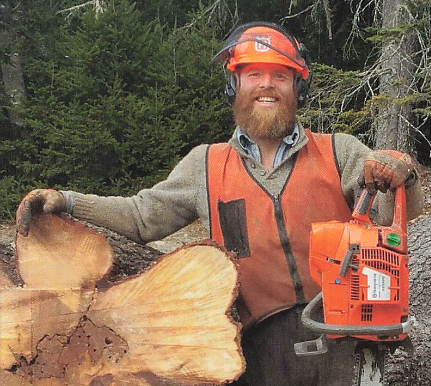
Fox Forestry - Turning a niche into a global business
Published April 28, 2025 By Jack Beaudoin
It’s said that some entrepreneurs are straight arrows, while others are zig-zaggers. The straight arrows plot a careful course from Point A to Point B, moving with all deliberate speed toward a destination that they’ve kept their eye on since the very beginning of their careers. Zig-zaggers, in contrast, seem to end up at their station by chance, following their interests wherever they lead. Not every move is successful, but no individual move is so drastic that failure is fatal. Tom Fox of Orland, Maine-based Fox Forestry is a zig-arrow. Or maybe a straight-zagger. He’s not quite sure which yet.
“I always intended to do this kind of work,” the 48-year-old said of the forestry management business he founded in 1996. “I was really blessed with knowing what I wanted to do.”
But over the past three decades, his insatiable curiosity driven by a goal to revolutionize the way forestry is done at any scale - has led him in directions he never imagined. There’s Fox Incorporated, which imports and sells specialized forestry equipment like portable sawmills and firewood processors, particularly brands from Sweden, Germany, Norway and Finland. Then there’s Fox Forestry, LTD in New Brunswick, launched to gain a foothold in equipment sales in Canada. He acquired a sawmill manufacturer in Pennsylvania, and acquired the rights to sell an innovative kiln, made in Italy, that produces thermally modified wood that could replace pressure treated lumber and enable lower-value material to be used in a wider range of construction applications.
In fact, the need to solve the challenges his forestry team faced as they served residents of Maine’s coastal islands - a clientele that ranges from fishermen to Fortune 100 executives - drove Fox to far-flung corners of the world, from Addis Ababa, Ethiopia, to Örebro, Sweden.
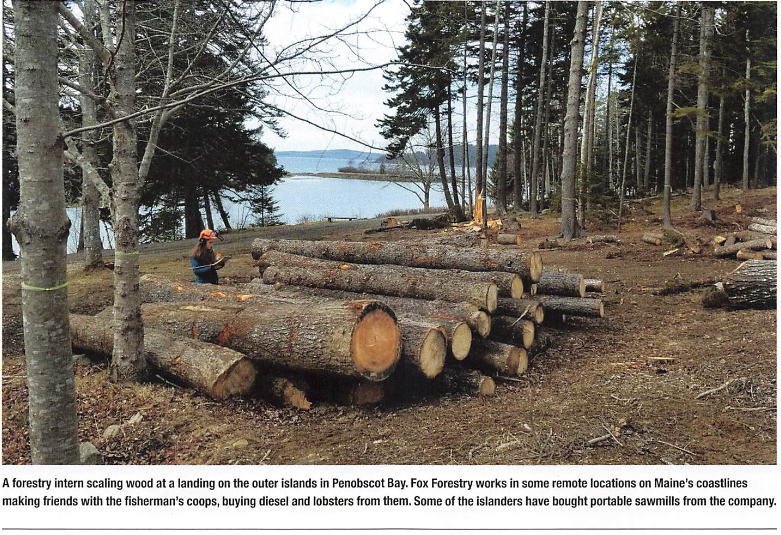
“That’s how the whole sales side got started,” Fox said, remembering a trip to the World Forestry Fair in Scandinavia ten years ago. He was in search of economical and efficient ways to generate value from the thinning and harvesting on the islands. “We were basically using our challenges and then leaning into them one-by-one. Once the first sawmills arrived, we started using them so that when we filled out our harvest notifications, we could have a commercial interest. And then that grew into us being able to then sell these sawmills to the residents of the islands. So now we are selling band sawmills to the fishermen who live on the islands and then supplying the fishermen with logs to mill out their own lumber. And so, we’ve created this circular economy on these islands.”
Today, he shakes his head recalling the odd swerves his career has taken.
“The desire to go out and import machines didn’t come from anywhere but our need for these machines,” he said. “I really wasn’t expecting, nor did I know what skills I needed to really grow a sales company, but when sales started coming, they were coming so fast that I didn’t have a choice to keep up with ‘em.”
Getting His Start
Having grown up in New York’s Catskill Mountains, Fox spent much of his adolescence in the woods. “I had a good mentor that I grew up with who taught me trapping and hunting, and I spent a lot of time outdoors with him,” he recalls. The idea of living and working in the northern forest appealed to him, but his schoolteacher parents insisted he go to college. He chose Paul Smith’s College in the Adirondacks, and before he graduated, he’d already begun his career.
“I was a subcontractor working with a licensed forester,” Fox explained. “He took me under his wing. I worked in New York State in the Catskill Mountains at that time, doing 480-A tax exemption timber marking. So, I learned how to do this really intensive marking, which I loved. And then I would calculate by species, the diameters and the volumes, and then I would create timber sales at a very young age.”
Fox then went to the University of Maine’s forestry school and expanded his work by incorporating some of the first growth modeling programs into his single-person operation. Although he had prepared himself academically for industrial forestry, he quickly realized the coastal communities ringing Acadia National Park presented another option, and one closer to his heart.
“I started managing properties on Mount Desert Island, and I got in with some really, let’s just say, well-to-do customers who had a lot of resources and wanted the best forestry practices,” Fox said. “Everybody always talked about the coast of Maine as being one of the biggest challenges - you couldn’t do this or that because the wood isn’t worth enough to get it off the islands. But when I got here and started practicing forestry on the coast, it turned out a lot of these landowners are really willing and able to practice forestry, and they really are interested in the forest health.. And that focus within the shoreland helped our growing company establish its niche.”
Island Hopping Challenges
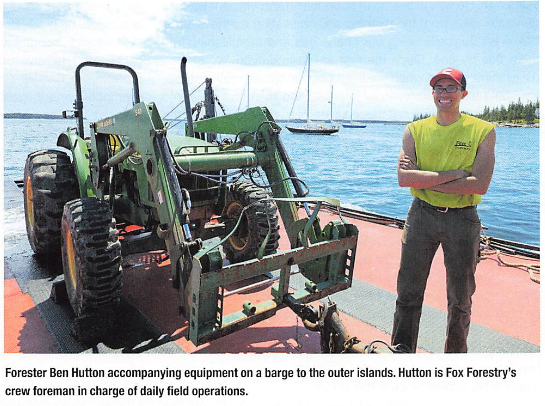
While the headcount over the years has ebbed and flowed like the tide, Fox Forestry employs between 10-15 people, many of whom have graduated from the University of Maine or Maine Maritime Academy. Those from the latter have proven useful when Fox is moving its equipment on and off barges that ferry them out to the islands they serve, occasionally bunking out overnight on a small spit of forest miles from the mainland.
“It’s kind of like an old-fashioned logging camp feeling when we go out there and bring all of our equipment,” Fox said. “You have to pack really well for the islands. You must have all your tools. You have to have a really good plan on what you’re doing.”
“And there’s nobody better than this guy to back up a loaded bucket truck or pieces of equipment across a stone beach,” Fox added, pointing out Forestry Specialist J. Benjamin Hutton, a UMaine graduate. “He’s got nerves of steel, a calm confidence even when loading equipment on the heaviest seas.”
“Did I think I’d need to know how to swim when I was in forestry school?” Hutton says. “No, it’s been a huge learning curve for sure. But rising to the challenge seems like it’s part of this company’s nature.”
Today, Hutton supervises the forestry crews - enabling Fox to generate business, cultivate new clients and retain existing customers. On-the job-training has given Hutton the opportunity to hone his skills as a mentor to new employees and to deal responsively to the sometimes-eccentric needs of landowners.
Former manager Ben Arruda, now the forestry manager for the City of Bangor, said Fox Forestry was a great place for him to land after getting an associate’s degree in forestry in 2018.
“I wanted to do small scale forestry and arboriculture,” he said. “I needed to complete four years of forester training under a licensed forester, and Tom was the right person to learn from. He stands out in a crowd and is one of the nicest people you’ll ever meet.”
Welcome to Forestry Land?
The company’s latest venture is what Tom Fox calls a forestry “theme park” and meeting center, just off Route 3 in Orland on the road to Acadia National Park. In the middle of the lot s t a n d s a partially finished three story wood timber building, surrounded by sawmills, boilers and a few pieces of small logging equipment. Scattered throughout are neat piles of sawn lumber and logs ranging from firewood length right up to the gigantic trunk of a 200-year-old elm harvested in nearby Blue Hill that recently succumbed to Dutch Elm disease.
Right now, it’s definitely a work in progress. But Fox is less interested in the site as it stands today and more interested in its future use.
“We could host meetings and fly in people from around the world,” he says, inspired by the global forestry conferences he has attended. The attraction- to marry meeting room discussions about innovative forestry practices with an exhibition space in which the machinery required to turn vision into reality could be demonstrated in action.
“It goes back to having these sorts of big goals on how we can revolutionize our industry,” Fox said. “How can we revolutionize our forest management and forest products industry throughout the state of Maine and around the world? And it’s through having these forest management opportunities where we’re working in these coastal places, and then we’re cutting the right trees for the right reasons to get the forest healthy.”
Lately Fox has been working to bring together such disparate organizations as the Maine Technology Institute and the New England Forestry Foundation to develop pilot projects that would use smaller, more maneuverable equipment for thinning and stand management, and to explore new forest products to increase the value of woodlots. That doesn’t mean cutting more but cutting smarter - a way to manage forests of all sizes to store more carbon and, at the same time, maintaining or even increasing the volume of fiber that’s coming off the land. Fox is eager to develop the modeling that shows how it can be done.
“If this code is to be cracked, I think that we could expect this to really grow and to impact the bottom line,” he said. “Not just the return on investment for the commercial company, but for the health of the forest, the ability to withstand weather events and disease. It’s a win-win, it’s going to happen, and this is why I’m interested in chasing it.”
Publication data
title: Fox Forestry - Turning a niche into a global business
date: 2025-04-28
outlet: Northern Logger
words: 1623