Getting to know Maine’s Black Tupelo trees
see original on Maine Woodlands - September 2026
September 1, 2026
by Jack Beaudoin
No two tree walks are ever the same. The walk leader, the time of year and perhaps most of all, the location, impact what a participant might see and learn. Even walks separated by less than 20 miles can present dramatically different mixes of species depending on the elevation of the land, proximity to water, micro-habitats — even the age of the woods.
That’s why the opportunity to join the Maine Woodland Owner’s Tree ID Day at Ferry Beach State Park on June 6 was impossible to resists. While many visitors use the small park near the mouth of the Saco River to access a seven-mile stretch of sandy beaches, it is a hidden gem for those of us with a sometimes-unreasonable fascination with forests.
Led by former Portland city arborist Jeff Tarling, the walk attracted individuals and families from across Maine and beyond, offering them an insider’s view of a Gulf of Maine Coastal Lowland forest. As the walk’s description pointed out, it was a chance to get up close and personal with Pitch Pine, growing in sandy soils where few other species have managed to adapt, and a beautiful stand of tall Black Tupelo (Nyssa sylvatica).
According to Forest Tree of Maine, “Black tupelo, or blackgum, is found in Sagadahoc, Androscoggin, Cumberland and York counties and as far north as Southern Oxford County and Waterville in Kennebec County.” Since that list represents about a third of the state, you might be forgiven for thinking it’s fairly common. But the guide goes on to note that “it is not commonly found except in very wet areas” such as fens, forest edges, stream bottoms and other freshwater shore land. They are easy to identify in silhouette: a relatively tall leafy tree with a swarthy bole — nearly two feet in diameter in older trees — with thin, nearly horizontal branches distributed regularly from crown to trunk.
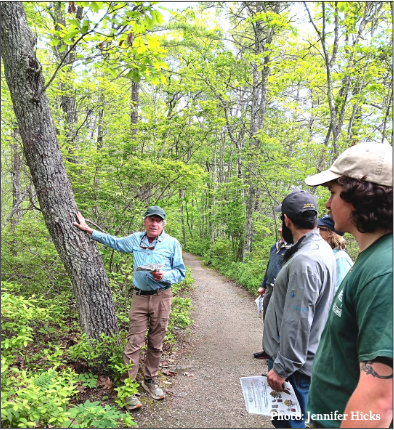 Jeff Tarling discusses the natural history of a tall Black Tupelo at Ferry Beach State Park
Since our walk took place in spring, it was far too early to see the bright, fiery red and orange foliage for which the species is rightly celebrated. Still, what impressed the participants on the walk was the tupelo’s size relative to its neighbors — in a relatively wet environment, the Ferry Beach individuals we saw outgrew nearby oaks (both Northern Red Oaks and White Oaks), birch and maples, competing for the canopy’s top spot only with the mature Eastern White Pine. On of the children on the walk said the tree’s dark, deeply ridge bark reminded him of Groot, the tree-like alien character from Marvel Comics’ Guardians of the Galaxy franchise.
After the walk, I asked Jeff for more information on these magnificent trees. The exchange has been edited for length.
MWO: What impressed you most about the Black Tupelo trees you saw?
JT: Native Tupelo trees are quite rare in Maine and the stand at Ferry Beach State Park perhaps the most accessible to view. Their late September to early October bright red fall foliage rivals or exceeds red maple. Ferry Beach Tupelos are a real treat to visit in the Fall.
MWO: What makes that foliage standout?
JT: The pigment “anthocyamin” in the leaf cell is responsible for the bright ruby red foliage once the chlorophyll drops off in late September. It’s really red!
MWO: How old do you think those trees were? How does that compare to other tree species found in Maine?
JT: Typically, slow growing trees near wetlands are some of our oldest. That’s partially because they were small, slow growing with challenging access and they weren’t logged. Looking at the older Tupelo specimens in Saco, I’m guessing they could be centuries old. The Fox Forest Tupelos in New Hampshire are estimated at around 700 years old. In comparison, slow growing White Oak like those in Portland’s Deering Oaks can be over two centuries old. Red Spruce in Northern Maine, trees in Big Reed Forest, and White Pine in the Ordway Grove in South Paris are among of our oldest.
MWO: Are tupelo important to any wildlife species in particular? Are there any species that have developed a “tupelo niche?”
JT: Tupelo are good early spring pollinators (Tupelo Honey) and produce an edible drupe in the Fall, thus is a food source for wildlife.
MWO: I’ve heard that today Black Tupelo had little commercial value, except perhaps for pulping. What other values do tupelo trees offer?
JT: The low commercial value might relate to rarity. The wood is known to be light and strong once used for plow shares. Tupelo is listed as a deer resistant, shade tolerant hardwood which could be of interest. With ash and beech in decline, tupelo and basswood might gain favor in some areas. I’ve planted a number of Tupelos in residential landscapes even as street trees and they have done well. So you don’t need to be in a wetland situation to enjoy this tree. Tupelo stock is available in a variety of sizes from local nurseries and are definitely worth looking into for ornamental and perhaps trial reforestation. I’ve seen replanting in woodland areas where ash were lost with good results with minimal care.
Publication data
title: Getting to know Maine’s Black Tupelo trees
date: 2026-09-01
outlet: Maine Woodlands (September 2026)
words: 850