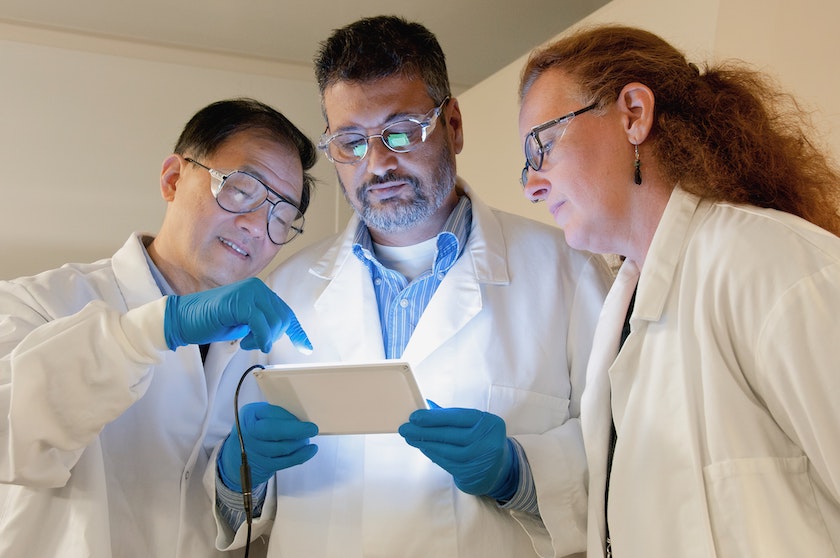
 Photo by National Cancer Institute on Unsplash
Leveraging Analytics to Drive Population Health
The team approach is critical to wellness and disease prevention.
By Jack Beaudoin
According to HIMSS Analytics, more than three out of every four healthcare organizations in the United States have now initiated at least one PHM program. Slightly more than 60 percent of the surveyed organizations reported that they had two or more such programs in place, and providers indicated that they are gradually taking on higher levels of risk. At the 2018 HIMSS Global Conference, there were more than 25 population health sessions and a Solutions Lab dedicated to helping the providers navigate and create new PHM programs.
As a data-driven endeavor, population health applies a broad spectrum of healthcare resources to treat specific conditions in clearly defined populations. This approach promises to fulfill the goals of the Quadruple Aim — better care for individuals, better outcomes for populations, greater staff satisfaction and lower overall costs.
But sustainability has proved difficult. Despite some success stories, many population health programs never get beyond the pilot phase. Three approaches, however, can overcome barriers and support quick wins and a foundation for ongoing success.
Constrain complexity
When HIMSS Analytics asked respondents to identify the challenges they faced in population health, three top areas stood out: technology, resources and data. The problems ranged from a failure to define and engage distinct populations, to difficulties integrating critical technology into clinical workflows and, more than anything else, to an inability to ingest data from other sources to design interventions and measure outcomes.
“Many of the challenges organizations currently face with their population health strategy involve technology, specifically with a lack of understanding around the technology needed to move forward,” the study found. At the same time, providers “are finding challenges with the level of resources they can dedicate to the implementation and sustainability of population health initiatives.”
“It is not always easy for organizations to create the right programs for their patient population,” said Shelley Price, Director of Payer and Life Sciences for HIMSS North America. “They have different technologies in place. They have different strategies and priorities. And they are working, frankly, under various and very different payment programs, all of which have their own individualized — and sometimes unique — requirements for outcomes and care.” This complexity often leads to frustration. At HIMSS18, Price met the leader of a small rural hospital in Utah who was ready to throw in the towel on population health. “We’re overwhelmed; what we’ve tried isn’t effective; and, frankly, we don’t know what we’re doing,” he told her. “We just hope we’re going to get bought by someone who’s big and knows how to do population health.”
That story doesn’t surprise Jonathan Scholl. The former Chief Strategy Officer and Head of Business Development of Texas Health Resources, one of the largest faith-based, nonprofit healthcare delivery systems in the United States, helped define and roll out that system’s population health strategy prior to becoming President of Leidos Health. Scholl has observed that many organizations struggle with their early PHM efforts because they focus on outcomes first — without understanding the depth of the issues they will confront along the way.
Instead, Scholl recommends that every PHM initiative start with three distinct, measurable parameters:
➤ Who, exactly, will be targeted?
➤ What, exactly, are the health measures you seek to improve?
➤ How, exactly, are those measures to be managed and improved?
“When we start with the answers to these three questions, we immediately constrain complexity,” he said. “Then, if we just do what we already know how to do with increased precision, with lower variation and with more repeatability, we’ll achieve better outcomes at a significantly lower cost.”
As an example, Scholl noted that a detailed comprehensive congestive heart failure program provides an opportunity for a high-value, low-complexity PHM initiative. “There are many models of best practice, but few automate and track compliance and results in real time to consistently meet or exceed targeted goals,” he said. “The data needed to provide increased precision with lower variation resides in multiple systems of record and only after you pull it all together, for all caregivers inside and outside the walls of the hospital to review and track, and make it actionable within the clinical workflow can you see the desired impact.”
Focus on variations in care
Many population health programs that grab today’s headlines are using artificial intelligence and machine learning to draw inferences from unstructured data buried deep in an organization’s data repository. As important as those programs may become, Scholl thinks most providers can make transformational changes now simply by focusing on something more obvious. “Healthcare’s next five to 10 years will see a burgeoning of data ingestion, availability of data analytics, and data scientists looking for patterns, correlating and generating Big Data hypotheses for solving problems,” he predicted. “But most organizations – and their patients – could benefit now from ‘Little Data and Big Workflow.’”
By that, Scholl means that analytics should be used to identify variations in care. Recognizing and “eliminating variation around how we care for patients with diabetes, congestive heart failure, COPD, asthma – clinical conditions that account for well over half the medical spend in the United States – would make significant improvements in health status and significant reductions in expense,” he said. The biggest, fastest wins come “when you model for a population, either through personalized medicine or through history, the predictors of deviation from best practice or from best clinical management.” “
Data analytics certainly helps inform population health decisions and are a key component to help stratify patients by their risk and to develop insights into the obstacles they may face,” Price agreed. “But we don’t often talk about the stratification of providers. Analytics can improve how real-time information is translated in order to make better decisions, through dashboards and data visualizations, so that a provider can understand how well he or she is doing with individuals or the population as a whole. They can benchmark themselves against others in their field and then discover or develop best practices to enact positive changes to improve health outcomes.”
To emphasize this point, Scholl uses the example of a Leidos client that performed total joint replacements for a population of Medicare Advantage patients. “During the entire length of stay in this particular hospital, if the patient ever has a pain score greater than six, then the length of stay goes up a day and a half, which is a huge cost for the hospital and a complication for the patient,” he said. “So, the workflow around pain management – in order to keep pain scores under six – is a significant driver of lower costs and higher quality.”
Scholl’s key takeaway: “Focus on clinical conditions of the population that come into the hospital and make sure that the key indicators of high quality are actually getting done.”
Go beyond the EHR
For many population health pioneers, the implementation of an EHR seemed sufficient to launch new initiatives. “Why did we start doing population health? Because suddenly we thought we could,” observed Robert Havasy, Senior Director of Health Information Systems with HIMSS North America who specializes in connected care. “We spent a trillion dollars on a bunch of shiny, new EHR technology and data-capture technology, and boards were asking what they spent all that money for. So, hospitals began to use EHRs as data repositories, and most are terrible at that. Then they tried to layer analytics tools over a reporting layer, and the whole process became cumbersome, slow.”
EHRs are vehicles to assist care and gather data, Price agreed, “but they are just one of many technologies, analytics and data sources that true population health requires. The EHR is able to capture some of the history and patient experience, but we haven’t been good at developing one source of – or federated access to – a full picture of a patient.”
That picture now includes claims data, clinical data from the EHR, unstructured notes, an increasing variety of medical images, continuous data streams from remote patient monitoring instruments and consumer health devices, and the emerging importance of social determinants data. But data proliferation is not tantamount to greater knowledge. For that, a provider needs a data integration and management strategy, the right analytic tools and a workforce with data- specific skills.
“Healthcare providers are realizing that true population health requires a much deeper level of analytics capability than most hospitals or healthcare systems currently have, and now they’re going back to rebuild or build out their analytics capability,” Havasy said. That may explain why analytics is the fast-growing category in the 2018 U.S. HIMSS Leadership and Workforce Survey. Ranked ninth a year ago, data analytics and clinical/busi- ness intelligence is now fourth on the priority list for hospitals.
Scholl believes it is critical to make analytics affordable to all institutions regardless of their size. A managed service component – think “analytics-as-a-service” – might help critical-access facilities and smaller hospitals launch and sustain PHM programs for their own communities.
“Over time I think we have to sharpen and fine-tune population health programs, but you also have to get financing right, and we really haven’t done much on that,” he said. “For health systems to make that investment — either in technology or in managed services — what’s in it for them if they don’t have a financial model that rewards them for doing it?”
For his part, Scholl remains bullish on the future of workflow-driven population management. “Analytics can help us answer the critical questions,” he said. “What is the population? What are we managing to? How are we going to get paid for it? Once we have the answers to those questions, we can deploy the processes and workflows that will have a real impact on patient care.”
Keywords healthit
Published at HealthcareITNews.com.
About Healthcare IT News
Healthcare IT News was founded in 2003 by Neil Rouda and Jack Beaudoin. Today, it is the industry’s authoritative source covering the people, policy and technology driving next-generation healthcare in the U.S. and throughout the world. With hundreds of thousands of visitors each month, it is the place healthcare decision-makers go for timely, actionable news and analysis on the ever-changing health and healthcare landscape.
About Leidos
Leidos is a Fortune 500 science and technology solutions and services leader working to solve the world’s toughest challenges in the defense, intelligence, homeland security, civil, and health markets. The company’s 32,000 employees support vital missions for government and commercial customers. Headquartered in Reston, Virginia, Leidos reported annual revenues of approximately $7.04 billion for the fiscal year ended December 30, 2016.